
Walking around the city
Archaeological areas that may be visited on request
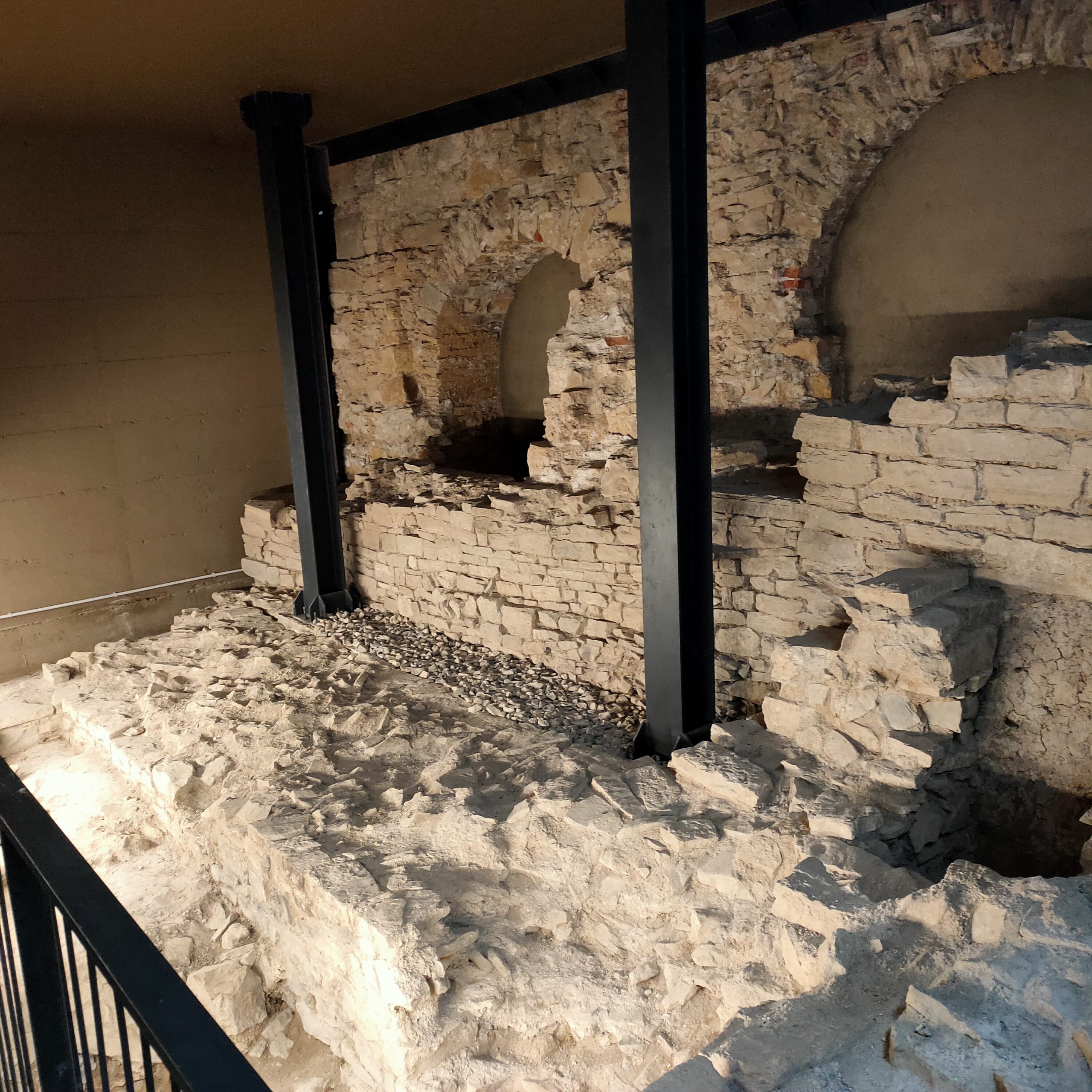
Vicolo Aquila Nera Archaeological Area
The Vicolo Aquila Nera area was brought to light in the 1980s, when a plan to build a book deposit for the Angelo Mai Civic Library led to excavation of an extended area behind the building. This site presents a cross-section through thousands of years of history, starting from the Golasecca Celts, the first inhabitants of the hill during the Iron Age, in the 5th century BC.
In Roman times, around first half of the 1st century BC, large-scale digging and levelling operations were made to build a domus which was used for a long time and then damaged by a violent fire around the mid-4th century AD. Part of this domus was inhabited also during the Early Medieval period.

The Roman road in Via del Vagine
A stretch of paved road and some structures from the Roman times were found in an underground room of a building in Via del Vagine. The road was built in the early 1st century AD using slabs of local limestone and slopes steeply; it ran parallel to a stretch of road discovered in nearby Via Tassis and together they probably bordered a block (insula) delimited to the south by Via Colleoni, the ancient decumanus maximus.

Archaeological areas inside other museums in the Upper Town
The area of the Roman forum (in the hall of Palazzo del Podestà, Piazza Vecchia)
A part of Bergomum’s forum, built in late Republican or early Augustan times, was discovered under the Palazzo del Podestà and the Teatro Sociale. A massive wall encloses a series of shops (tabernae) laid out around a porticoed square, which was entered by crossing a large stone threshold from a paved road that ran parallel to the decumanus maximus.
Little is known about the monumental appearance of Bergomum’s forum, due to the deep changes in the city centre after the Roman Age.

The Archaeological area inside the Cathedral Museum
Archaeological excavations under Bergamo’s cathedral have revealed that the early Christian cathedral of San Vincenzo was a three-aisled building, ornately decorated. To build it, during the 5th century AD, the Roman houses facing a paved road parallel to the decumanus maximus were demolished.
Of one of the domus, eleven rooms have been identified, with remains of frescoes and a black and white mosaic floor dating back to the 1st century AD.
The existence of an older domus – dated to the late 1st century BC – has also been detected: it had an entrance on the same street, but at a lower level. It was demolished in the 1st century AD, when all the area was rearranged – and floor levels were raised – to build more prestigious houses, close to the forum, erected in the same period.

Archaeological areas with free access
The cistern inside the Rocca
The remains of a Roman cistern with walls in opus incertum, made of pieces of stone bound by mortar, may be seen today in the Rocca complex, on S. Eufemia hill.
This cistern belonged to the water supply system built by the Romans to assure a constant and regular water distribution to Bergomum’s inhabitants. Several Roman cisterns have been discovered in the Upper Town, both public and private: some of them are still visible, while for others we only have historical information.
The most impressive and better-preserved cisterns are in the underground floor of Santa Grata monastery, four of which are still in operation. Other cisterns have come to light in Colle Aperto, in via Porta Dipinta and on San Giovanni hill.
We know that a cistern discovered in 1961 during roadworks in Colle Aperto was located at a depth of three metres, while a very large cistern, found in 1944 near Porta Sant’Alessandro, had an estimated capacity of one and a half million litres of water.

A large public building in Vicolo Sant’Agata
Beneath the former church of Sant’Agata, now a restaurant, archaeological excavations have brought to light the remains of some walls, perhaps belonging to residential buildings, dating between the late 1st century BC and the early 1st century AD. These structures were demolished during the 1st century AD to build a massive wall with protruding avant-corps, probably part of a monumental public building overlooking the decumanus maximus, now Via Colleoni. Some structures discovered in another restaurant in Via Colleoni 17 and the imposing column base found in the middle of the road – now on display at the Archaeological Museum – Iikely belonged to the same building.
The building was abandoned and demolished between the 4th and 5th century AD; Later, in the same area, the early medieval church of Sant’Agata was built: some tombs of its cemetery are visible in the archaeological area.
